The Problem With Legacy Methods
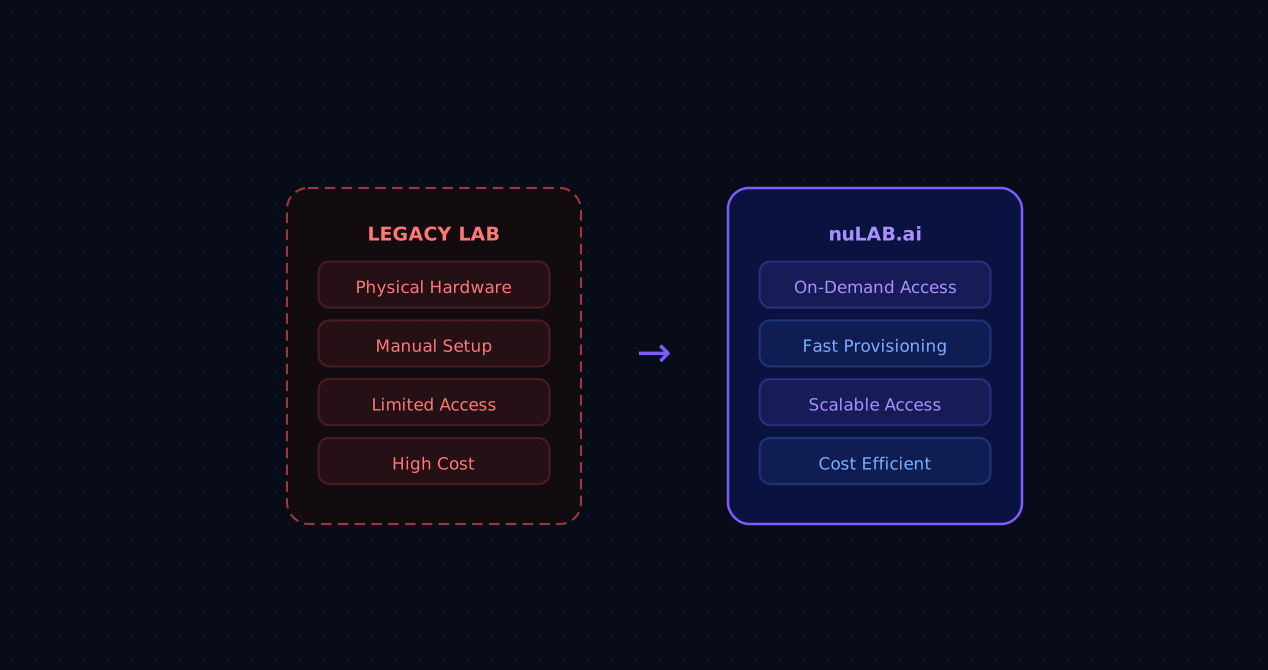
Most legacy lab workflows have the same weaknesses. They depend too heavily on physical hardware. They require time-consuming setup. They are expensive to maintain. They often support only a limited number of users at once. They create bottlenecks across teams. And in many cases, they slow down learning and validation instead of enabling it.
A traditional lab can become a constant source of delay: a team wants to validate a design, but the hardware is already in use. An engineer wants to test a change, but the topology must be rebuilt first. A student wants more hands-on practice, but access is restricted. A consultant needs to show a proof of concept, but standing up the environment takes too long.
These are not small inconveniences. They affect cost, productivity, project speed, confidence, and quality of execution.
Why the Industry Is Moving Away From Old Lab Models
The industry no longer has the luxury of slow validation cycles and rigid access models. Infrastructure has become more complex. Teams are more distributed. Certification and training expectations are higher. Customers want answers faster. Enterprises want proof before rollout. Technical talent needs hands-on readiness, not theory alone.
Physical labs still have a place in specific final-stage validation scenarios, especially when testing exact hardware behavior matters. But as the primary model for training, design validation, proof of concept work, and day-to-day engineering preparation, legacy methods are too slow and too expensive for what modern teams actually need.
What nuLAB.ai Does Better
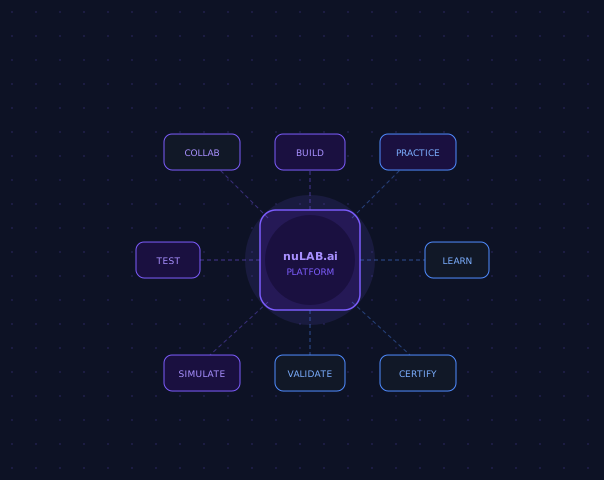
nuLAB.ai replaces the slow parts of legacy lab work with a platform built for speed, flexibility, and practical use.
- Instead of waiting for hardware availability, users can access labs on demand.
- Instead of manually rebuilding the same environment again and again, teams can create structured topologies faster.
- Instead of being limited by one room, one rack, or one physical setup, users can work from wherever they are.
- Instead of treating collaboration as an afterthought, teams can share environments and work together in real time.
- Instead of forcing learning and validation through outdated infrastructure constraints, nuLAB.ai gives users a more direct path to real technical practice.
A Better Model for Engineers
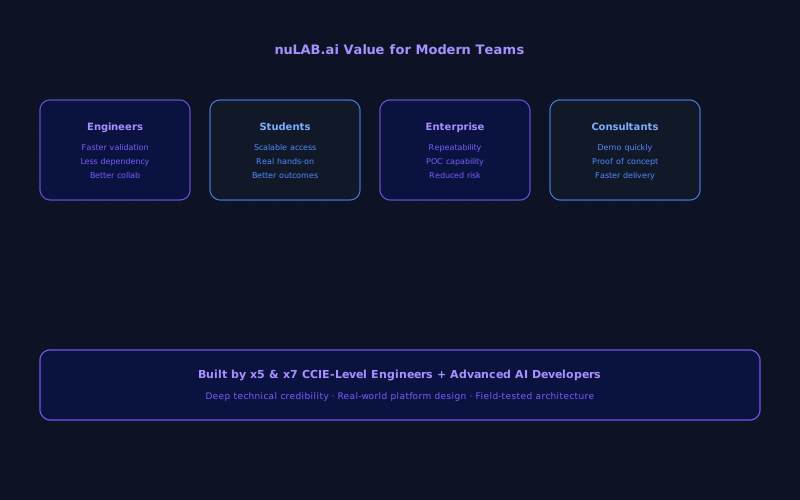
Engineers do not need more obstacles. They need environments that help them move. With nuLAB.ai, technical teams can build topologies, test ideas, validate configurations, and prepare for production work in a structured environment that is available when needed. Fewer delays. Less dependency on physical availability. Faster validation cycles. Stronger design confidence. Better collaboration across teams.
A Better Model for Students and Training Organizations
Traditional lab access has always been uneven. Some learners get the hands-on time they need. Many do not. That gap creates weak preparation and uneven outcomes. nuLAB.ai helps close that gap by making practical lab access more available, more scalable, and more repeatable. Students can practice in realistic environments. Training organizations can deliver structured hands-on experiences without carrying the full burden of expensive hardware labs.
A Better Model for Enterprises
Enterprises need more than training. They need validation, repeatability, and speed. They need teams to test before rollout. They need environments for internal learning. They need proof of concept capability without wasting time and money on constant physical buildouts. nuLAB.ai supports that model directly — giving enterprise teams a more efficient way to prepare, validate, and collaborate without being trapped by the overhead of legacy lab operations.
Built by People Who Understand the Problem
nuLAB.ai was built through the combined strength of elite networking talent, including team members with some of the most prestigious certifications in the world — including x5 and x7 CCIE-level achievement — together with advanced AI developers. This is not a generic tool built without field experience. It is a serious platform shaped by people who know what real engineers, students, and enterprises actually need.
Can nuLAB.ai Replace Legacy Methods?
In most day-to-day use cases, yes. It can replace slow access models, much of the manual overhead, the dependency on limited shared physical environments for many training, testing, and validation tasks, and the idea that progress must wait for lab hardware.
The smarter approach: use modern lab platforms for speed, scale, readiness, and repeatability. Use physical hardware when exact hardware dependence genuinely matters. nuLAB.ai helps organizations make that shift.
Final Thought
The future of technical readiness will not be built on waiting for hardware, rebuilding the same environments by hand, and accepting delay as normal. It will be built on practical access, realistic simulation, structured validation, and the ability to move faster without losing technical depth.
nuLAB.ai is not just another lab platform. It is a better operating model for how modern teams learn, test, validate, and prepare for real-world work. It gives the industry a path away from legacy friction and toward faster, smarter, more practical technical execution.

"Physical labs should be reserved for the cases where they are truly required — not used as the default answer for everything. That is the smarter model."
Share this article: #nuLABai #LegacyLabs #TechnicalReadiness